Views: 0 Author: wpc ksl Publish Time: 11-19-2026 Origin: ANHUI KSL


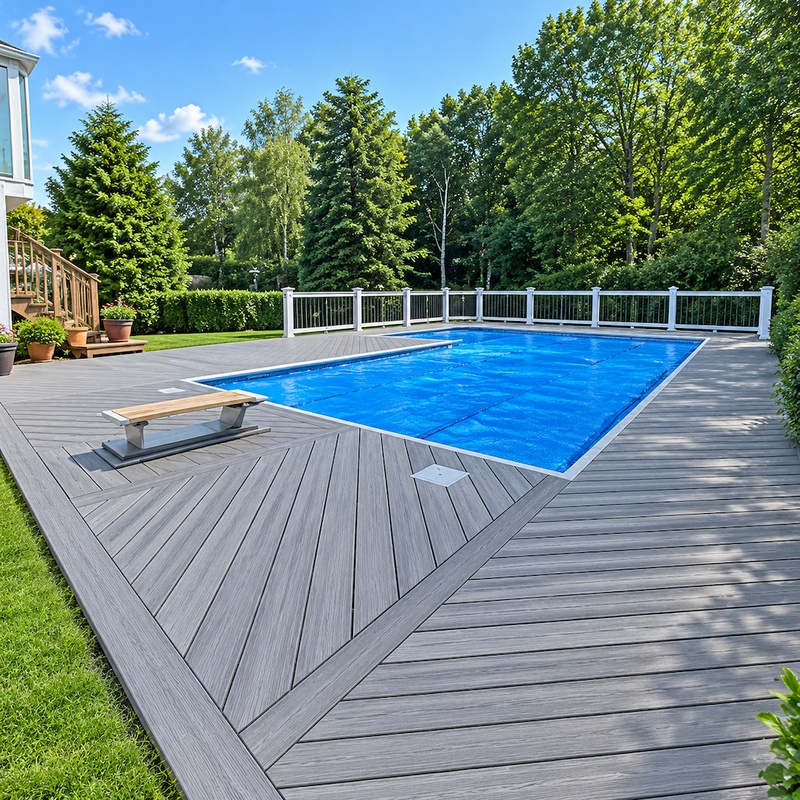
Commercial swimming pools and seaside resorts are the most punishing outdoor environment a decking material can face. Chlorinated splash zones, salt-laden sea fog, barefoot traffic, 90°C+ surface temperatures and constant wet-dry cycling attack every joint, fibre and fastener. This engineering guide explains how 360° capped co-extrusion WPC decking from ANHUI KSL NEW MATERIAL CO., LTD. is built for these conditions — covering polymer science, UV and salt-spray performance, anti-slip safety classification, drainage and substructure detailing, plus real project lifecycle cost data.
360° capped shield: a 0.5–0.6 mm co-extruded PE/ASA shell fully encapsulates the WPC core — top, sides, underside and the hidden clip grooves.
Water absorption ≤ 0.1% (ASTM D570 / EN 15534-1), eliminating swelling, rot and freeze-thaw cracking at the pool edge.
R11 / Class C anti-slip rating (DIN 51130, wet barefoot test) with a 3D deep-embossed matte grain.
3,000 h QUV ΔE ≤ 2.5, plus 1,000 h neutral salt-spray (ASTM B117) with no blistering or substrate exposure.
25-year limited commercial warranty, zero annual oiling, and a 15–30% lower 10-year total cost of ownership than teak or ipe.
First-generation WPC was a single homogeneous extrusion of HDPE and wood flour. Because the wood fibres sit exposed at the surface, they absorb moisture, support mould growth and grey out under UV. Second-generation “capped” boards solved part of the problem with a laminated top film — but the cut edges and the underside stayed unprotected.
True 360° capped co-extrusion is a simultaneous dual-extruder process: the structural core (approximately 55% recycled HDPE, 35% refined wood flour, 10% functional additives) and the protective shell are fused at the die head while both are still molten, producing a chemically bonded — not glued — molecular interface. The shell wraps the entire profile perimeter, including the tongue-and-groove or groove-only edges and the clip channel.
Core function: flexural strength, screw holding power and thermal stability (flexural modulus ≥ 3,800 MPa).
Shell function: moisture barrier, colour retention, scratch resistance (pencil hardness 2H+) and the anti-slip micro-texture.
Interface function: a co-extruded tie layer prevents delamination under repeated thermal cycling from −30°C to +70°C.
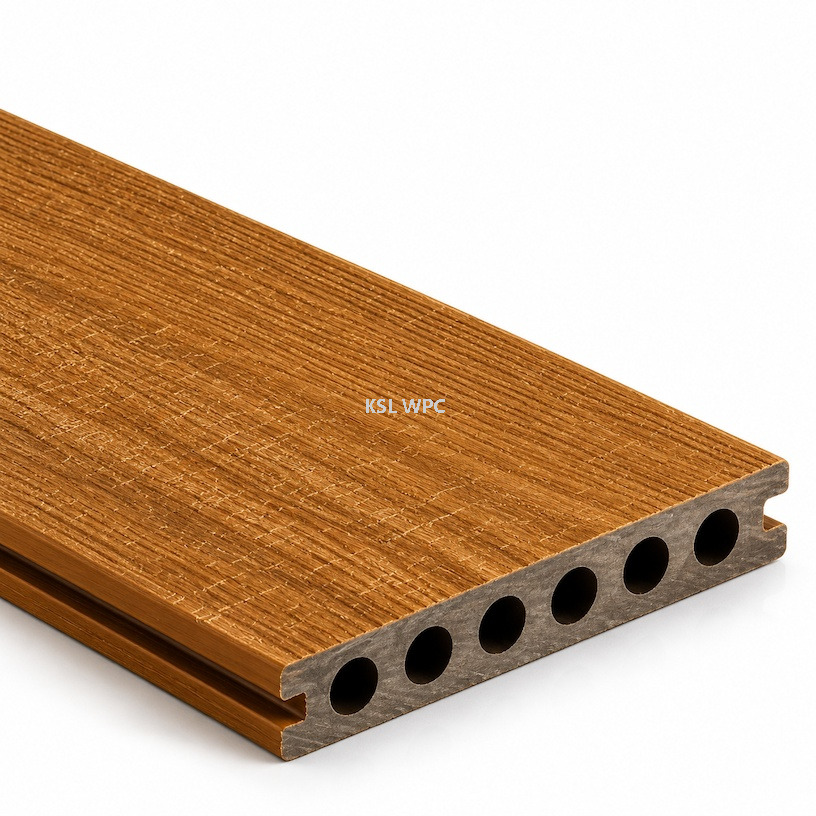
Co-extruded shell with 3D embossed wood grain — the same texture that delivers the R11 wet anti-slip rating.
Seaside resorts combine three degradation mechanisms at once: UV radiation (up to 6,000 MJ/m² annual dose in the Gulf and Mediterranean), chloride ion attack from sea spray, and thermal shock where a 70°C deck meets 24°C pool water. Unprotected composite chalks and fades within two seasons; timber checks and splinters within one.
KSL's capping compound uses an ASA (acrylonitrile-styrene-acrylate) modified polyethylene outer layer. The acrylate rubber phase absorbs UV energy without chain scission, while the styrene-acrylonitrile matrix keeps the pigment locked in. Accelerated weathering results:
QUV / ISO 4892-2, 3,000 hours: colour change ΔE ≤ 2.5 (visually imperceptible), no chalking.
Neutral salt spray, ASTM B117, 1,000 hours: no blistering, no rust bleed, no shell delamination — verified on 316 stainless clip interfaces.
Freeze-thaw, EN 15534-1, 150 cycles: mass loss < 0.4%, no cracking at the board edge.
Chlorine immersion, 500 h at 5 ppm: surface colour and hardness unchanged.
For specifiers, this means the aesthetic warranty — not just the structural warranty — becomes meaningful in a marine exposure class (ISO 9223 category C4/C5). KSL issues project-specific colour-retention guarantees for seafront installations based on these test reports.
Slip-and-fall liability is the single largest safety exposure at a commercial pool. Most jurisdictions reference one of three test standards: DIN 51130 (ramp test, R-class), DIN 51097 (barefoot wet ramp, A/B/C class) or AS 4586 (pendulum, P-class).
KSL pool-grade profiles achieve R11 under DIN 51130 and Class C under DIN 51097 barefoot testing, equivalent to AS 4586 P4/P5. The result comes from three combined design decisions:
Macro texture: a 0.8–1.2 mm embossed grain depth that channels water away from the foot contact patch instead of trapping it.
Micro roughness: mineral-free matte finish (Ra 3.5–5.0 µm) so the surface stays grippy even with sunscreen residue and pool chemicals present.
Drainage geometry: optional grooved “pool-edge” profile that increases open drainage area by roughly 30% versus a flat board.
Note that R11 must be maintained, not just specified: never seal or coat a capped board, and clean with a pH-neutral detergent. Aggressive acid washing is the most common cause of premature loss of slip resistance.
Around water, the deck is only as good as the layer beneath it. KSL recommends the following specification for commercial pool surrounds, seaside boardwalks and rooftop terraces:
Parameter | Commercial Pool / Seaside Spec | Residential Reference |
|---|---|---|
Joist spacing (c/c) | ≤ 300 mm (12″) for 25 mm boards | 350–400 mm |
Sub-frame material | Hot-dip galvanized steel or 6063-T5 aluminium | H3 treated timber or WPC joist |
Drainage fall | ≥ 1.5% away from pool coping | 1.0% |
Ventilation gap | ≥ 100 mm clear under structure | 50–80 mm |
Fasteners | 316 stainless steel hidden clips | 304 stainless clips |
Expansion gap | 4–5 mm per board end + 10 mm at walls | 3–5 mm |
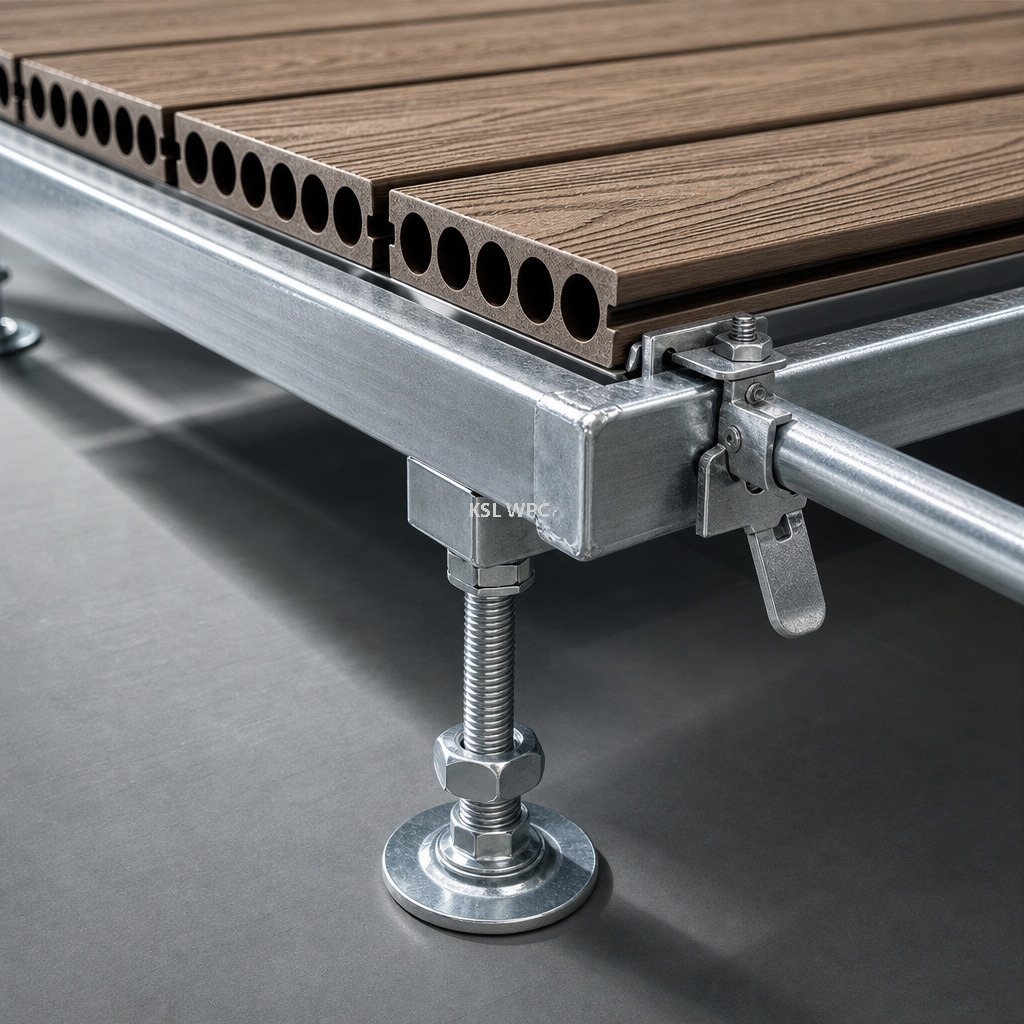
Galvanized steel subframe on adjustable pedestals — the recommended detail for level changes and free drainage around pools.
Additional site rules learned from waterfront projects: keep the finished deck a minimum of 150 mm above the pool coping water line or provide a slot drain; never butt a board tight against a wall or planter kerb; and detail a sacrificial stainless starter clip at every free edge exposed to prevailing onshore wind and spray.
Performance Metric | 360° Capped Co-Extrusion (KSL) | Traditional 1st-Gen WPC | Hardwood Timber (Teak / Ipe) |
|---|---|---|---|
Water absorption (24 h) | ≤ 0.1% | 1.5–3.0% | 8–15% |
Wet slip resistance | R11 / Class C (P4–P5) | R9–R10 | R9 (slippery when wet) |
Chlorine & salt-spray resistance | Full polymer encapsulation, 1,000 h B117 pass | Surface bleaching, edge swelling | Fibre degradation, metal staining |
UV / colour retention | 3,000 h QUV, ΔE ≤ 2.5 | Greying, chalking in 2–3 yrs | Greys without annual oiling |
Splinter / barefoot safety | Splinter-free | Occasional fibre lift | Frequent splinters, checks |
Annual maintenance | Soap and water only | Occasional pressure wash | Sanding + oiling 1–2×/yr |
Service life (wet exposure) | 25–30 years | 10–15 years | 8–12 years (if maintained) |
Commercial warranty | 25 years limited | 10 years | None from manufacturer |
A 240-key resort on the southern Chinese coast replaced 1,800 m² of failed ipe decking around three pools and a beach bar. The original timber had been sanded and oiled twice a year and still showed rot at 40% of joist contact points after nine years.
Pool surround installed with 300 mm joist spacing, 316 stainless hidden clips and a 1.8% drainage fall to slot drains.
Specification adopted: 25 × 140 mm 360° capped co-extrusion boards in slate grey, 300 mm galvanized joist centres over adjustable pedestals, 316 stainless clips throughout, and a grooved pool-edge profile at the coping line.
Ten-year total cost of ownership (per m², installed):
Hardwood (ipe), maintained: material + installation 1.0× baseline, plus oiling, sanding and board replacement at years 4, 7 and 10 — total approximately 1.55× baseline, with pool closures during works.
360° capped co-extrusion: material + installation 1.15× baseline, maintenance limited to two pressure rinses per year — total approximately 1.2× baseline, no closures.
The client also reported a measurable safety benefit: zero slip incidents recorded in the first 24 months of operation, compared with eleven claims in the final two years of the timber deck. For hotel operators, that single metric often justifies the upgrade on its own.
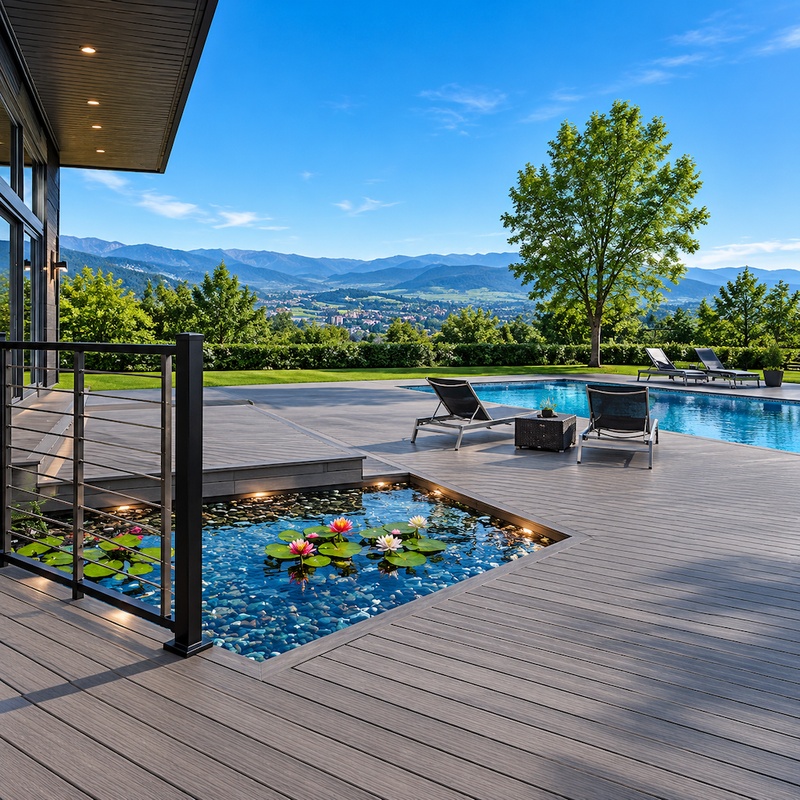
Villa pool terrace detailing: level transitions handled with pedestals rather than stepped joists.
State the exposure class (ISO 9223 C4/C5 for seafront) and the required slip rating (R11 / Class C) in the specification, not just “anti-slip”.
Require 360° capping, including cut edges, in writing — ask for a cross-section sample of the clip groove.
Demand third-party test reports for water absorption, QUV and salt spray with the batch numbers.
Fix joist spacing at 300 mm and specify 316 stainless fasteners for any installation within 500 m of the shoreline.
Detail drainage before aesthetics: fall, slot drains, ventilation gap and expansion joints.
ANHUI KSL supplies project documentation packs — test reports, CAD details, installation manuals and colour samples — with every commercial quotation.
Engineering-grade 360° capped co-extrusion WPC decking for commercial pools, seaside resorts and waterfront projects. Factory-direct pricing, free technical samples and full project documentation.
Official email: Dora@China-wpcdeck.com | Ella@China-wpcdeck.com
Official Alibaba Store / Verified Supplier Store
Instagram| TikTok| Facebook| Twitter (X)
Factory Address: Hefei, Anhui Province, China | https://www.china-wpcdeck.com/

Add:
Circular Economy Demonstration Park, Suzhou, Anhui Province

Tel: whats App
+86-13866161113